
The founding spirit of Naturefriends
Naturefriends began in a world that felt unfair and unbalanced. At the turn of the 20th century, industrialisation was reshaping Europe, transforming cities into dense centres of labour where access to nature became a luxury. For many working-class families, free time was scarce, and green spaces were almost unreachable. Nature was something seen far away from factory windows, not something experienced.
The first Naturefriends organisation emerged in Vienna in 1895 as a form of resistance to this inequality. They believed that contact with the outdoors should not be a privilege but a right; not only for recreation, but as a source of dignity, health and education. By the 1920s, the movement had over 100,000 members and was running its own youth sections, huts, sport and cultural events to connect political awareness with environmental action.
Through the collective construction of their own Naturefriends Houses, they built a strong sense of community and solidarity, showing the practicality of their motto: “Berg Frei!” (Mountains Free!). It was the first ever alternative to the “Berg Heil!” (Mountains Be Greeted!) slogan and lifestyle, belonging to the elitist and inaccessible Alpine Clubs. More than a simple catchphrase, Berg Frei became the political statement at the core of the organisation, marking red as the first colour-value of NF.
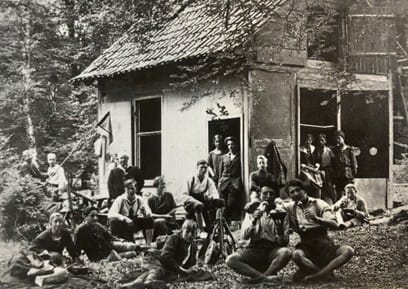
Repression, Resistance, and Rebuilding
The ideology of fascist regimes that rose across Europe in the 1930s was in deep contrast with what Naturefriends stood for. They feared youth movements that taught independent thinking and solidarity. Consequently, bans and restrictions were applied in almost all countries. Yet, Naturefriends persisted in their existence. In Austria for example, illegal central administration continued to bravely manage the activities of subject specific working groups.
Some did not continue their political education, while others worked in semi-legally camouflage activities for the resistance. In the alpine border region of Switzerland, they disguised their assemblies as excursions in the ‘Naturefriends-style’. Despite the caution, the risk was huge. In territories occupied by Nazis, being found guilty of such actions could lead even to death penalty.
As a matter of fact, there are plenty of examples for Naturefriends who lost their lives in Gestapo prisons or concentration camps. A striking remnant of this dark chapter is this inscription that German Naturefriend Gottfried Wiedemann found carved into his prison wall:
(Lampasiak, Gruber, Pils, 2009, p. 51)
“And if you imprison us in the jail behind walls,
Do you think this will force us down?
It almost looks like it, it seems to be true,
But believe me, once we will recur!
Berg frei!"
The reorganization of the different Naturefriends in Europe began with the advance of the allied forces, and with fascism being overthrown in Italy. Eased by the maintenance of the semi-legal structures and the sustaining of the small groups in the resistance movement, the reconstruction of the official Naturefriends network developed quickly from 1945 onwards.
Bringing IYNF to life
This post-war restart unfolded in a continent undergoing rapid change, bringing to the forefront a heterogeneity that had always been part of Naturefriends, but never as strongly as in this moment. The larger the movement became, the more varied its members were, by country, by culture, and by generation.
What united everyone was a shared commitment to nature, solidarity, and community; but how these ideals were lived and interpreted naturally differed. Young members were entering a world transformed by new social questions, rising environmental concerns, and a growing desire for international cooperation. Their expectations were not in opposition to those of adults; they simply reflected a different experience of the times.
By the early 1970s, youth groups across various countries were increasingly engaging with intercultural exchange, emerging ecological debates, and creative forms of activism.

They cherished the legacy of the movement, yet they also sensed that their own way of organising was evolving. It was becoming more informal, more international and more openly political. This meant a growing need for the space to let this new spirit take shape. This wasn’t a rupture; it was an organic evolution within a movement that had always believed in participation and democracy.
Recognising these needs, youth representatives from Austria, Germany, France and the Netherlands, began meeting to discuss how a dedicated international youth structure could strengthen the whole movement. The conversations were long, thoughtful, and sometimes complex, reflecting the mosaic of perspectives inside the Naturefriends family. Adults and young delegates exchanged ideas on responsibility, autonomy, and the best way to maintain unity while giving youth the freedom to innovate. It was never about separating but about ensuring that young people could play a meaningful role in shaping the future of the organisation
From these discussions grew the conviction that an international youth organisation capable of developing its own programmes, reacting swiftly to social issues and creating activities shaped by young people themselves would bring new energy to the entire movement. Working groups began to take shape, draft directives were examined in detail and refined step by step until a shared agreement emerged.
In 1975 this vision became reality with the establishment of the Naturfreundejugend Internationale, known today as IYNF. It was independent in its structure yet firmly connected to the values of the wider Naturefriends movement, and it embodied a simple but powerful idea: each generation must have the freedom to express Naturefriends principles in its own voice. The new youth branch soon developed into a lively centre for intercultural seminars, environmental education, political reflection and international youth exchanges that carried the spirit of “Berg Frei!” into a new era.
The creation of IYNF did not mark a break from the movement’s history but its continuity. It was proof that Naturefriends could adapt, evolve, and remain relevant by listening to its youngest members. And it affirmed a core belief that has guided the organisation ever since: that change, when grounded in shared values, strengthens rather than divides.

IYNF’s evolving identity
During the 1980s, IYNF still carried a strong connection to the socialist tradition in which it had grown. Its collaborations within broader socialist youth networks and its own programmes made this heritage clearly visible, and many activities of the time placed political education at the forefront. Yet with the turn of the decade bringing new social current shaping young people's life, the organisation gradually started to rethink how its values could be expressed in a more inclusive and progressive way. What followed was not a break with the past but a conscious broadening of perspective. The strongly defined red identity softened into a more open political stance that preserved a social consciousness while letting go of rigid ideological boundaries.
This evolution coincided with a remarkable moment in IYNF’s history. At a time when Europe was still divided, the organisation became one of the very first international youth NGOs to reach beyond the Iron Curtain. Meetings, exchanges and international camps brought young people together who had long been separated by political barriers.
When participants from East and West marched side by side under shared banners, they discovered that curiosity, solidarity and the simple wish to learn from one another could bridge divides that had once seemed immovable. This openness made IYNF a natural partner for newly emerging organisations in Central and Eastern Europe that sought international cooperation without being tied to any strict political ideology.
As the network expanded, the organisation’s physical presence shifted as well. The IYNF office moved gradually eastward, travelling through Belgium, the Netherlands, and Germany before settling in Prague in 2002, while keeping its legal seat in Vienna. This relocation reflected a clear intention to be closer to those member organisations that most benefited from a direct and supportive presence. The move did more than change an address; it strengthened the sense that IYNF belonged to the entire network, not just to a single corner of Europe.
With the organisation entering a new phase of maturity, attention gradually turned inward, towards the way IYNF was structured and how it operated daily. For a long time, the organisation had relied on a rather traditional and hierarchical model, in which services and opportunities were mainly delivered from the top down.
While this approach had ensured continuity, it increasingly felt misaligned with the reality of a movement shaped by active, connected and self-organising young people. A long process of reflection and organisational development led to a shared understanding: IYNF’s true strength did not lie in managing complexity, but in enabling relationships.
This realisation marked a decisive moment in the organisation’s modern history, leading to a conscious shift in becoming a facilitator of networks. The focus moved towards connecting individuals, groups and member organisations across borders and levels, according to shared interests, fields of activity or emerging social and environmental issues. Creating spaces for peer exchange, mutual learning and joint projects became central.
In 2008, this renewed self-understanding was captured in a simple but powerful motto: Connect & Inspire. It expressed a vision of IYNF as an international youth NGO that empowers young people to live the movement’s values through cooperation rather than hierarchy.
While this approach had ensured continuity, it increasingly felt misaligned with the reality of a movement shaped by active, connected and self-organising young people. A long process of reflection and organisational development led to a shared understanding: IYNF’s true strength did not lie in managing complexity, but in enabling relationships.
This realisation marked a decisive moment in the organisation’s modern history, leading to a conscious shift in becoming a facilitator of networks. The focus moved towards connecting individuals, groups and member organisations across borders and levels, according to shared interests, fields of activity or emerging social and environmental issues. Creating spaces for peer exchange, mutual learning and joint projects became central.
In 2008, this renewed self-understanding was captured in a simple but powerful motto: Connect & Inspire. It expressed a vision of IYNF as an international youth NGO that empowers young people to live the movement’s values through cooperation rather than hierarchy.

At the same time, the network itself continued to grow and diversify, prompting a broader reflection on what “Europe” could mean in practice. Rather than a fixed geographical boundary, it increasingly came to be understood as a shared space of dialogue, values and cooperation, one that naturally included countries such as Azerbaijan within the IYNF network. Alongside this ongoing European development, the network also began to extend beyond the continent, with a new member organization emerging in Senegal. In 2025, IYNF marked its 50th anniversary, a milestone that reflected not only the organisation’s longevity, but also its continued ability to evolve, expand and remain meaningful for new generations of young Naturefriends.
This renewed clarity also strengthened relationships within the wider Naturefriends family. After decades of parallel development, IYNF and NFI deliberately invested in closer cooperation, recognising their mutual dependence and shared responsibility for the future of the movement. Joint publications, combined events and intergenerational initiatives reflected a growing willingness to learn from one another and to share methods, knowledge and best practices.
Rather than blurring roles, this collaboration highlighted them: IYNF as an active, experimental and forward-looking youth organization, and NFI as a rooted and experienced backbone of the movement. Together, they reaffirmed that shaping the Naturefriends of tomorrow is a task best approached collectively.
Within this evolving framework, a wider palette of values began to take shape. The blue focus on youth participation, personal development and experiential education grew stronger, while the green focus on nature, direct environmental experience and sustainability became central to the organisation’s identity. By defining and embracing these evolving priorities, IYNF solidified its role. How exactly these roles are implemented is a question answered daily by our Presidium, Secretariat and volunteers, whom you can find more about in the other sections of the website.